 Save
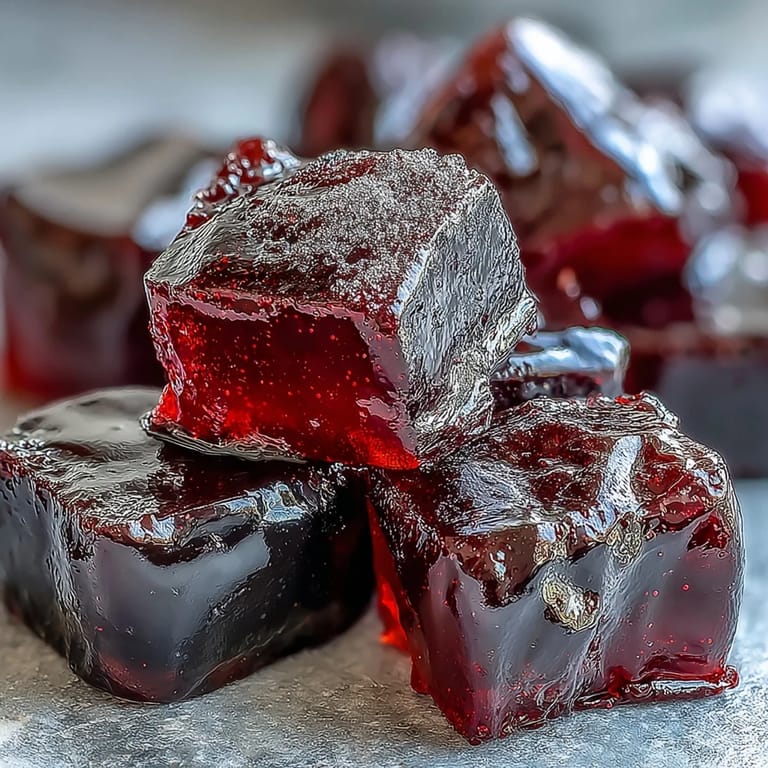
Save There's something about black currant that stops me mid-chew—that sharp, almost forbidden tartness that somehow pairs perfectly with licorice's mysterious warmth. I discovered this combination entirely by accident one rainy afternoon when I was experimenting with gelatin confections and grabbed the wrong bottle from my extract shelf. The mistake turned into something I couldn't stop making, a candy that tastes like a secret shared between two old friends who understand complicated flavors.
I made these for my grandmother's bridge club once, nervous they were too weird, too bold for people who usually reach for traditional hard candies. She bit into one, closed her eyes, and said they tasted like remembering something she'd forgotten. After that, every time she saw me she'd ask when I was making another batch—that's when I knew I'd stumbled onto something real.
Ingredients
- Black currant purée: This is your foundation, the voice that carries the whole conversation—use fresh or frozen currants blended smooth, then strain out any seeds so your candy has that silky texture.
- Lemon juice: A tablespoon might seem small, but it brightens the black currant and keeps the candy from tasting muddy or one-dimensional.
- Granulated sugar and corn syrup: Together they create that perfect chew—the corn syrup keeps crystals from forming while the sugar builds structure.
- Water: Use cold water for blooming gelatin and room temperature for the sugar syrup to help it dissolve evenly.
- Powdered gelatin: This is what transforms liquid into that satisfying wobble and chew; don't skip the blooming step or you'll end up with grainy candy.
- Licorice extract: A little goes a long way here, so start conservative and adjust to your taste—some people want subtle, others want it to announce itself.
- Salt: This tiny pinch makes all the flavors pop and prevents the candy from tasting overly sweet.
- Confectioners sugar and cornstarch: Your anti-stick duo that keeps the pieces from welding together and makes them pleasant to handle.
Tired of Takeout? 🥡
Get 10 meals you can make faster than delivery arrives. Seriously.
One email. No spam. Unsubscribe anytime.
Instructions
- Prepare your stage:
- Line an 8x8-inch pan with parchment paper and give it a light grease so your finished candy releases cleanly. Having everything ready before you start is the difference between a smooth process and one where you're scrambling while the syrup cools.
- Bloom the gelatin:
- Sprinkle gelatin over 1/3 cup of cold water and let it sit untouched for 10 minutes—this creates tiny pockets that absorb liquid evenly, preventing lumps. You'll see it transform from powder to a spongy mass that's ready to dissolve.
- Warm the fruit base:
- Gently heat your black currant purée with lemon juice over low heat, just until it's steaming—you're not cooking it, just warming it to help the gelatin dissolve smoothly.
- Cook the sugar syrup:
- Combine sugar, corn syrup, and 1/3 cup water in a separate pan, stirring over medium heat until the sugar fully dissolves. Once it's clear, clip your candy thermometer to the side and stop stirring—let it boil undisturbed until it reaches exactly 250°F, which takes about 15–20 minutes.
- Bring syrup and gelatin together:
- Remove the syrup from heat immediately when it hits temperature, then stir in your bloomed gelatin until it completely disappears into the hot syrup. This creates the base that will give your candy that perfect tender chew.
- Marry the flavors:
- Pour the syrup-gelatin mixture into your warm black currant purée and whisk gently but steadily until smooth and homogeneous—this step takes about 2 minutes and creates a beautiful uniform color.
- Season to your taste:
- Stir in the licorice extract and salt, then taste on a clean spoon—if it needs more licorice depth, add a bit more extract now while the mixture is still liquid. This is your moment to make it yours.
- Pour and set:
- Working quickly, pour the mixture into your prepared pan and spread it evenly with an offset spatula or the back of a spoon. Let it cool at room temperature for 1–2 hours until it's completely set and pulling away slightly from the sides.
- Cut and coat:
- Mix confectioners sugar and cornstarch together, dust your cutting board generously, then turn out the candy slab onto it. Using a sharp knife, cut into roughly 1-inch squares and toss them in the coating mixture until fully dusted.
 Save
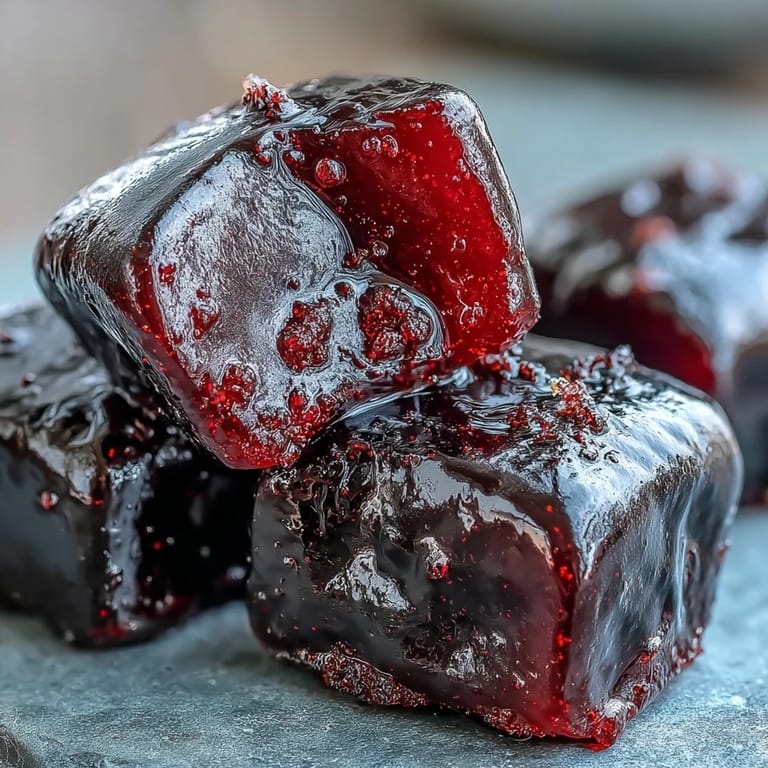
Save There's a moment when you pull the candy slab from the pan and it jiggles slightly that you know you've done it right—that tender, yielding surface promises a candy that will stick pleasantly to your teeth for a moment before melting away. Years later, someone will tell you they can still taste this candy in their memory, and that's when you understand why it mattered.
The Black Currant Question
Fresh black currants are rare in American supermarkets, which is honestly a shame because they have a complexity that frozen ones sometimes lose. I've learned to work with frozen, which actually works beautifully once thawed and blended—the freezing breaks down the cell walls and sometimes makes the puree smoother. If you absolutely can't find black currants, black raspberries give you that same tart intensity, though you'll lose some of the almost-medicinal licorice quality that makes black currant special.
Temperature and Timing
The 250°F temperature for your syrup is crucial because it's the point where sugar has lost enough water to create that signature chew without being so dry that it becomes brittle and snaps instead of yields. I once tried shortcutting this by cooking to 245°F because I was impatient, and the candies turned into near-marshmallows that stuck together no matter how much cornstarch I used. Since then, I've learned to trust the numbers and give the syrup the full time it needs to reach that exact point.
Flavor Customization and Storage
The beauty of homemade candy is that you can adjust the licorice intensity to match your own taste—some people want it subtle and mysterious, others want it bold and unmistakable. I've experimented with adding finely ground licorice root powder for deeper flavor, which works beautifully if you like a more authentic, herbal note. Store your finished candies in an airtight container away from humidity, and they'll keep for about a week before the edges start to harden slightly.
- Keep a notebook of your extract amounts so you can recreate your favorite version next time without guessing.
- If your kitchen is humid, the candies might soften faster—consider storing them in the refrigerator during summer months.
- These make exceptional small gifts wrapped in parchment paper and tied with string, perfect for people who appreciate flavors that surprise them.
 Save
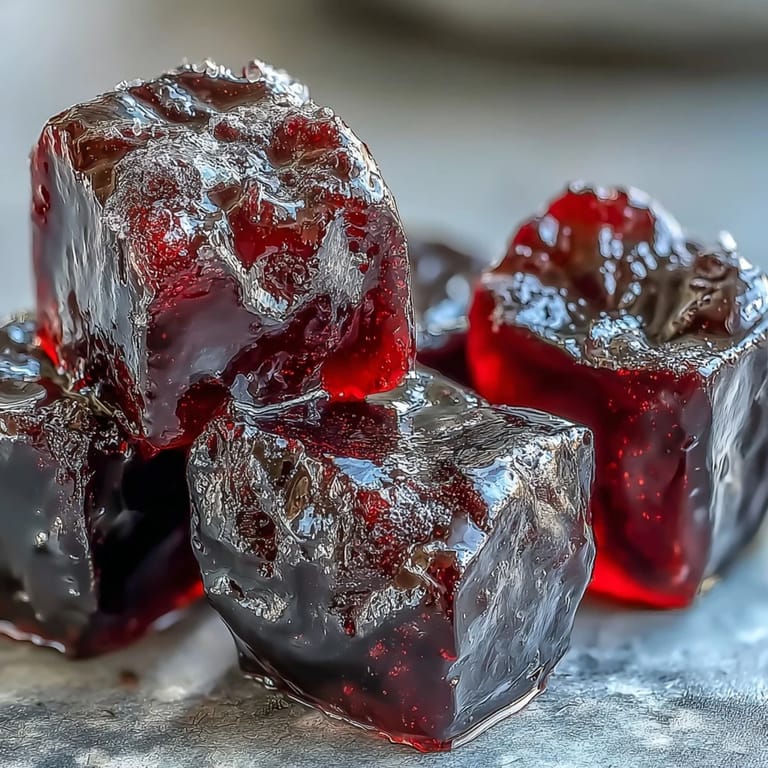
Save There's something deeply satisfying about unwrapping a piece of homemade candy and tasting exactly what you meant to create. This one, with its mysterious licorice whisper and tart black currant punch, has become the candy I'm known for making—and honestly, that feels like the highest compliment.
Your Questions Answered
- → What creates the chewy texture in this candy?
The use of powdered gelatin sets the mixture, providing the candy's characteristic chewy consistency.
- → Can the black currant be substituted with another fruit?
Yes, alternatives like black raspberry or blackberry purée can be used to vary the flavor while maintaining the candy’s tartness.
- → How does licorice extract influence the flavor?
Licorice extract adds a sweet, slightly aromatic depth that complements the tartness of the black currant, enhancing the overall flavor profile.
- → What is the purpose of the confectioners sugar and cornstarch coating?
Coating the candy pieces with confectioners sugar and cornstarch prevents them from sticking together and makes handling easier.
- → What tools are needed to prepare this confection?
A candy thermometer, saucepans, whisk, baking pan, sharp knife, and mixing bowls are essential for accurate preparation and shaping.